

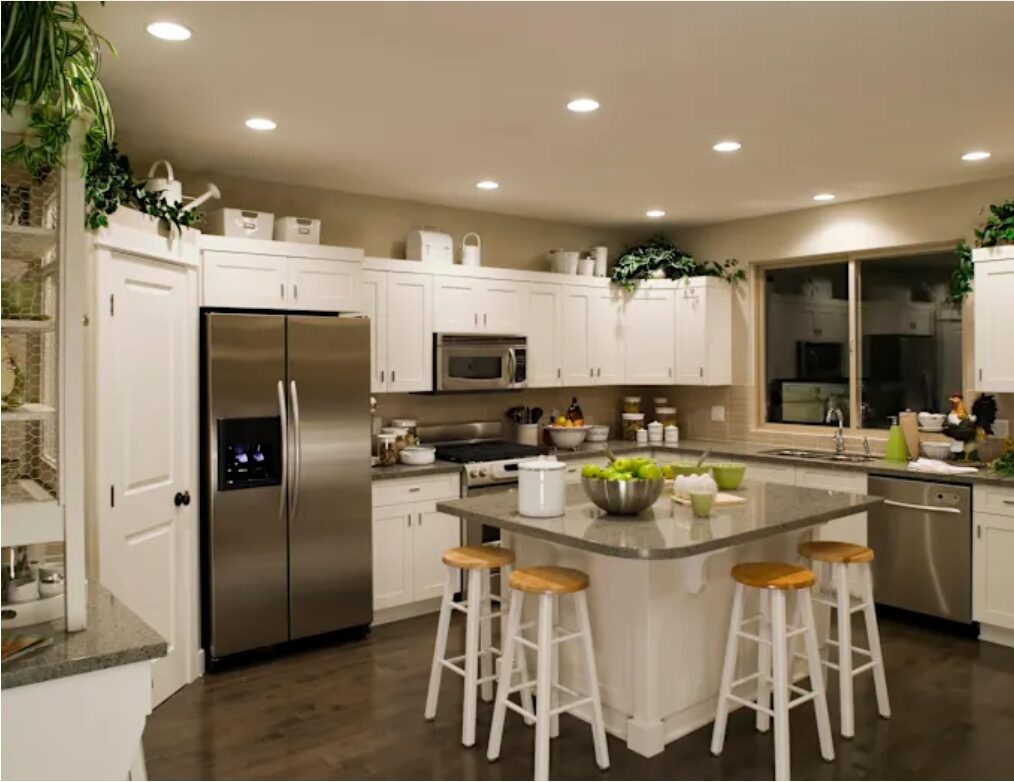
1. The “Invisible Damage” of Recessed Cool White Light
Recessed lighting fixtures (also known as downlights or ceiling lights) are marketed for their “clean and modern” look and are often installed extensively on kitchen ceilings.
However, if the bulbs used are cool white light with a K of 5000 or higher, a problem arises: the light becomes glaringly harsh, like an operating room, instantly transforming the kitchen from a “culinary paradise” into a “cold laboratory.”
The specific effects of this type of lighting include:
- Distorted food presentation: Fruits appear bland, meats grayish-white, and overall appetite is greatly reduced.
- A cold atmosphere in the space: The lack of warmth makes wooden cabinets and tiles look thin and uninteresting.
- Poor portrait effect: Facial shadows are harsh, making it uncomfortable to touch up makeup or chat in front of a mirror.
The designer points out that this is because kitchens need to simultaneously meet the requirements of “task lighting” (bright lighting for chopping vegetables) and “ambient lighting” (warm lighting for dining). Cool white light excels only at the former, completely failing at the latter.
2. Why do many people fall into this mistake?
When building or renovating a kitchen, homeowners are often misled by the idea that “high brightness = practicality,” choosing LED bulbs with high Kelvin values.
Developers often install cheap cool white bulbs by default, further reinforcing this habit.
Other common causes:
- Believing that cool lighting is “more modern and cleaner,” ignoring the essential home function of a kitchen.
- Using too many recessed lights, resulting in overall light that is too bright and too cold, lacking depth.
- Ignoring color temperature and choosing lights solely based on lumens.
The result: The kitchen functions fine, but after a while, it feels “off,” like walking into a fast-food restaurant.
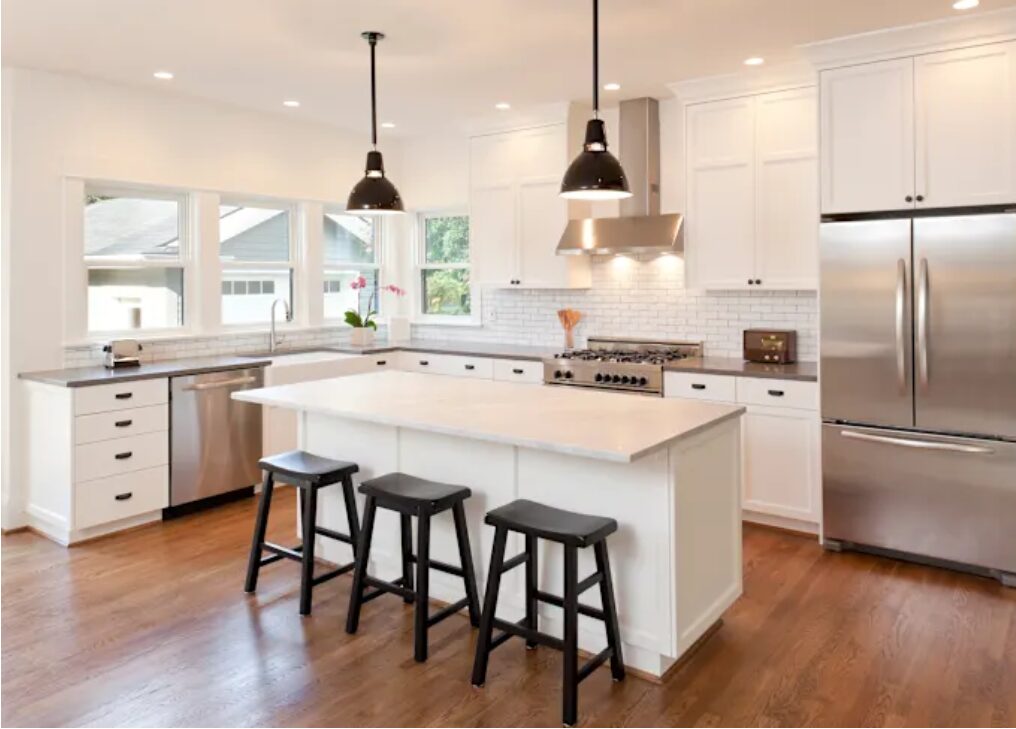
3. Correct Color Temperature Selection: The Kitchen’s “Golden Range”
The ideal color temperature for kitchen recessed lights is between 2700K and 3500K—warm white to neutral white, both bright and inviting.
Specific Recommendations:
| Color Temperature Range | Light Perception | Suitable Kitchen Scenarios | Example Effects |
| 2700K | Warm Yellow Candlelight | Dining Area, Island Area | Creates a cozy atmosphere for gatherings, making food look appealing |
| 3000K | Warm White and Soft | Main Work Area, General Lighting | Balances tasks and atmosphere, gives a natural look to skin |
| 3500K | Neutral White | Partial Lighting in Food Preparation Area | Clearly visible details, not glaring |
| 4000K+ | Cool White with Blue Tones | Storage Room or Garage Only | Avoid using as the main kitchen light |
Kitchen designers emphasize: 3000K is the most versatile choice, allowing marble countertops to show their texture and wooden cabinets to appear more deep.
4. Immediate and Feasible Repair Solutions
No need to demolish walls and rebuild; the following methods can quickly reverse the cold light problem:
- Replace Bulbs
- Choose adjustable color temperature LED modules (CCT switchable 2700K-5000K), a permanent solution.
- Prioritize high CRI (90+) bulbs to ensure accurate color reproduction.
- Install Dimmers
- Even with existing lights, dimming them can reduce glare and simulate a warm light effect.
- Low cost, easy installation, and immediate results.
- Supplement Layered Lighting
- Under-cabinet LED strips (warm white) + pendant lights or wall lights: Disperse the cold light pressure and create layers of light and shadow.
- Under-counter lighting is particularly effective, increasing the brightness of the work area while softening the overall atmosphere.
- Temporary Shielding
- Add frosted lampshades or filters for quick cooling (short-term solution).
These adjustments, usually completed in just half a day, can bring the kitchen to life.
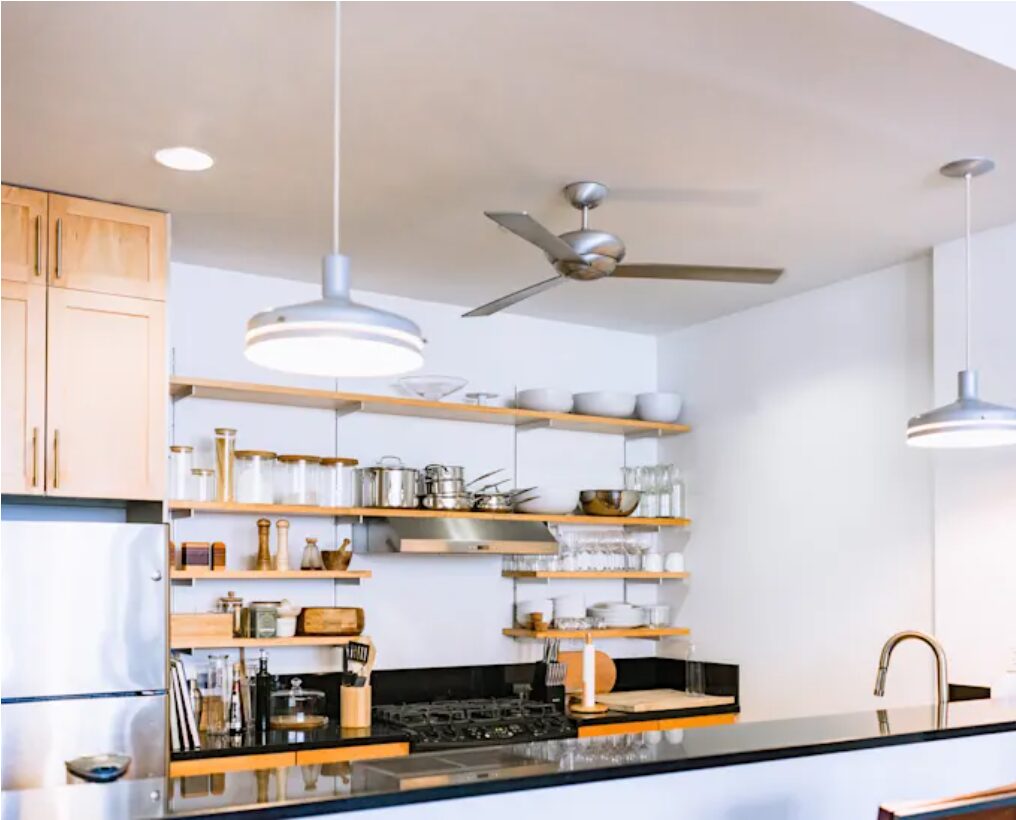
5. A Guide to Avoiding Pitfalls When Reinstalling Recessed Lighting
If you’re planning a new installation or major renovation, avoid these pitfalls beforehand:
- Spacing and Quantity: The spacing between lights should not exceed 1.5-2 meters to avoid an overly dense “grid” pattern; for a kitchen of 20 square meters, 6-8 lights are sufficient.
- Light Fixture Specifications: Use IC-grade (fireproof and insulated) light fixtures, compatible with the ceiling thickness; choose wide-angle (60°+) diffused light.
- Control System: Reserve multiple switches and intelligent dimming to support scene switching (cooking/dining/gathering).
- Test Lights: Purchase several bulbs of different color temperatures for on-site testing to ensure they match the cabinets and wall paint.
Professional lighting designers suggest: Kitchen lighting should be like “evening sunlight”—bright yet gentle.
6. How Light Reshapes the Soul of the Kitchen
A warm kitchen is not just about food, but also about emotions.
After switching to the appropriate color temperature, you’ll find that: the shadows cast by your hands when chopping vegetables are softer, the food looks and smells more appealing, and dinner time becomes more pleasant.
Remember, cool white light is suitable for offices or warehouses, but kitchens need a warm, inviting atmosphere—that’s what home should be like.